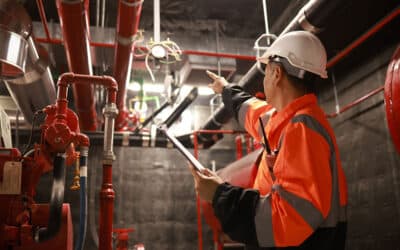
Fire safety in schools is not a once-a-year checkbox exercise. Instead of beginning and ending with a single risk assessment, it is a continuous legal duty that requires ongoing attention, robust processes, and clear documentation.
For multi-academy trusts (MATs) and schools with responsibility for multi-site estates, the task of keeping on top of fire safety compliance can be particularly challenging. The structures seen across school premises vary greatly in their age, building types, layouts, and materials. So, it can be a complex endeavour to maintain consistent, up-to-date, and well-documented fire safety management practices.
This guide will aim to clarify what the law demands, set out what good practice looks like in a school context, and explain why strong and centralised fire safety records deliver value well beyond basic compliance.

What are the legal requirements for fire safety in schools?
The principal legislation in relation to school fire safety is the Regulatory Reform (Fire Safety) Order 2005, also sometimes referred to as the “RRO” or “Fire Safety Order”. It applies to all non-domestic premises, including schools, academies, and colleges.
Under the RRO, the “responsible person” has a duty to make sure a suitable and sufficient fire risk assessment is carried out, as well as that it is regularly reviewed. For MATs, this “responsible person” obligation applies across every school in the trust’s portfolio.
A “suitable and sufficient” assessment must:
- Identify fire hazards on the premises
- Identify people at risk, such as pupils, staff, visitors, contractors, and those with additional needs
- Evaluate the risks and implement measures to remove or reduce them
It will also be necessary for the “responsible person” to record significant findings and actions taken, as well as to review the assessment regularly and when circumstances change.
The need for findings to be recorded and reviewed regularly underscores the benefit for MATs of holding their fire safety records in a single centralised compliance system.
Such trusts’ optimisation of fire safety across multiple schools can be made much easier when they don’t have to worry about documentation being scattered across individual sites.
Subsequent updates to fire safety legislation that are pertinent to schools include the Fire Safety Act 2021 and the Fire Safety (England) Regulations 2022. These provisions reinforce requirements around fire safety information, particularly for certain building elements.
This all sits within the broader framework of the Health and Safety at Work etc Act 1974 and the Management of Health and Safety at Work Regulations 1999.
Who is responsible for fire safety management in a school or academy trust?
It is worth being clear about exactly how the “responsible person” concept plays out across different schools and MATs:
- In maintained schools, it is the employer (usually the local authority) that holds primary responsibility, with the headteacher and governing body involved as occupiers. In practice, then, responsibility may be shared between these parties.
- For academies and MATs, the trust is the employer. This means the trust’s board holds the “responsible person” role across all its schools.
Day-to-day management is often delegated to an estates manager, site manager, or designated fire safety officer.
However, delegation does not remove or transfer legal accountability, which remains with the responsible person. So, if fire safety management is found to be inadequate, it is the trust that will be liable.
The RRO also requires the responsible person to appoint one or more “competent persons” to assist with putting fire safety measures in place.
As we have already touched on, achieving effective oversight of multiple schools can be challenging for MATs. However, this only further underlines the relevance and usefulness of a centralised platform like Vision Pro Software.
Even when day-to-day management is delegated to site level, such a cloud-based package can give the responsible person visibility across all schools in the trust. This will help draw their attention to the schools that are compliant, those that have outstanding actions, and schools that are overdue for inspection.
What does a fire risk assessment need to cover in a school building?
A school fire risk assessment must be tailored to the unique characteristics of educational premises.
Crucial building-specific considerations include:
- Older school buildings, such as those from the Victorian and Edwardian eras, often having compartmentation issues, legacy materials, and complex layouts requiring more detailed assessment
- Temporary or modular classroom structures potentially introducing different fire spread risks compared to other parts of the school premises
- Mixed-use spaces (such as school halls that are also used for evening community activities) creating varying occupancy patterns, which any assessment will need to account for.
The key elements for a school fire risk assessment to address will encompass:
- Fire detection and warning systems, including their type, coverage, and testing frequency
- Means of escape, covering such aspects as evacuation routes, emergency lighting, signage, and door hardware
- Firefighting equipment, including their types and locations
- Structural fire protection, including fire doors, compartmentation, and wall and ceiling linings
- Hazardous materials such as asbestos-containing materials (ACMs), which can pose major safety risks if disturbed in a fire, and therefore necessitate careful asbestos management
- Arson risks, in recognition of schools statistically being among the most common targets for deliberately started fires; an assessment should consider site security, waste management, and access control.
Fire risk assessments at school premises should be reviewed regularly and whenever significant changes occur. Examples of the latter include the addition of new buildings, refurbishment works, or changes to occupancy or use. Annual review is widely regarded as best practice for schools.
Vision Pro Software helps ensure the right frequency of reviews by allowing recurring fire risk assessment reviews to be scheduled in advance. Automated alerts are issued by this cloud-based platform whenever reviews are due, thereby minimising the likelihood of compliance issues being missed across a large and varied school estate.
What does ongoing fire safety management involve beyond the risk assessment?
It is crucial to recognise that a fire risk assessment is merely the foundation, rather than the entirety of a school’s fire safety obligations. Effective management requires systematic testing, maintenance, training, and recordkeeping.
Statutory testing and inspection requirements typically include:
- Fire alarm testing encompassing weekly call-point tests, as well as inspections every six months by a competent engineer (BS 5839)
- Emergency lighting undergoing monthly functional tests and an annual full-duration test (BS 5266)
- Fire doors being subject to regular checks (quarterly recommended) and annual inspection by a competent person
- Firefighting equipment receiving a yearly service by a competent contractor
- Evacuation drills being undertaken at least twice per academic year (recommended), with full records kept.
A high standard of recordkeeping is critical. All testing, inspection, maintenance, and drill records must be kept, not least so that they can be readily available for fire-authority inspection.
The documentation kept by schools and MATs should show what was tested, when, and by whom, together with the outcome. The information provided on the latter should include any defects that were identified, and any remedial action taken.
When it comes to fire authorities’ enforcement visits to schools, incomplete or poorly maintained logbooks are among the most common findings.
In light of this, school and MAT decision-makers ought to be aware that Vision Pro Software can hold a complete fire-safety logbook in digital format. This logbook contained within our software can include timestamped entries for every test, inspection, and drill across all schools in the given trust.
When a trust adopts Vision Pro Software, defects identified during inspections can be flagged, assigned to the relevant person, and tracked through to resolution, all within the same system. What’s more, our cloud-based platform can generate reports on demand for fire authority inspections. Such functionality removes the need to locate and compile paper records at short notice.
These features of Vision Pro Software give school estate managers full visibility, a defensible audit trail, and significantly reduced administrative burden across the premises for which they are responsible.
Staff training, too, is hugely important for schools and MATs. All personnel should receive fire safety awareness training at the induction stage, and regular refresher training thereafter. More in-depth training than this will be required for designated fire marshals, covering evacuation procedures, sweeps, and assembly points.
How do well-maintained fire safety records support your CIF application?
Fire safety issues are common priorities for Condition Improvement Fund (CIF) bids. Examples of urgent condition and compliance problems that can qualify for CIF funding include the likes of failing fire-alarm systems, non-compliant fire doors, inadequate compartmentation, and deficiencies with emergency lighting.
CIF assessors look for credible, independent technical evidence of need and urgency. Well-maintained records can significantly strengthen a fire-related CIF bid because they:
- Provide a current fire risk assessment that clearly draws attention to specific deficiencies
- Consist of historical maintenance logs that demonstrate a pattern of recurring issues, thereby showing the problem is systematic rather than a one-off
- Show responsible governance through proactive inspection, reporting, and remediation attempts
- Offer timestamped, structured data that is more credible and persuasive than retrospectively compiled documentation; after all, CIF assessors are experienced enough to tell the difference between the two.
When schools treat the management of fire safety records as a live, ongoing discipline, this will leave them more strongly placed to pick out CIF-eligible projects at an early stage. As a result, they can also be in a better position to compile compelling evidence in readiness for the opening of the CIF bid window.
Among such schools and trusts that have adopted Vision Pro Software, the necessary documentation will have already been organised and auditable throughout the year. The production of informative reports will therefore be a quick and simple exercise, rather than a last-minute scramble.
Conclusion: simplify your responsibilities with centralised compliance
Remember: fire safety compliance in schools is a continuous legal obligation, not a mere “every now and then” undertaking. Estates teams and trust executives who approach it with rigor and the appropriate systems will be in a stronger position on every front, including regulatory compliance, pupil and staff safety, operational efficiency, and access to funding.
For MATs managing varied and dispersed estates, consistency is difficult to achieve without effective tools and processes. Vision Pro Software answers this challenge by bringing together fire safety records, inspection schedules, risk assessments, and compliance documentation in one secure, centralised platform.
To experience for yourself how our cloud-based system can greatly help strengthen fire safety management across your trust, please don’t hesitate to request a demo today.