The processes involved in managing facilities and compliance across multiple sites are becoming increasingly complex.
From ensuring appropriate fire safety audits are carried out, right through to the tracking of legionella risks, organisations across a range of sectors face mounting regulatory pressures, siloed data, and manual processes that drain resources.
Well-chosen integrated workplace management systems (IWMS) can be the backbone of digital transformation for companies in regulated industries. This is because of the effectiveness of such cloud-based software packages in unifying compliance, risk, audit, and asset management into a single, centralised platform.
However, successful implementation of an IWMS is not just about the specific software a given organisation invests in; it also hinges on strategy, people, and processes.
With all this in mind, in this guide, we will set out the key steps, challenges, and best practices for a seamless IWMS rollout, tailored to the priorities and requirements of UK organisations navigating compliance-heavy environments.
Key Takeaways
- Integrated Workplace Management Systems (IWMS) bring compliance, risk, audit, and asset management together in one central platform—replacing fragmented tools and spreadsheets.
- Success depends on more than software: preparation, clear objectives, and stakeholder engagement are essential for a smooth rollout and lasting adoption.
- The right IWMS should be cloud-based, mobile-first, and adaptable to your compliance needs, enabling automation, real-time visibility, and measurable efficiency gains.
- Vision Pro Software exemplifies this approach, offering customisable templates, offline functionality, and proven results—74% faster reporting and 68% better risk assessment.

What is an IWMS and why is it worth implementing?
An IWMS is a single, central software platform that integrates facilities management, compliance, risk, and asset tracking into a cohesive system.
Organisations in such sectors as healthcare, education, or retail typically decide to adopt an IWMS as a replacement for comparatively fragmented tools and spreadsheets.
In doing so, these organisations can unlock significant benefits such as:
- Automation: an IWMS can greatly help streamline repetitive tasks like audit scheduling and reporting.
- Real-time visibility: instant access to vital compliance status and asset performance information is provided by these platforms.
- Reduced manual workloads: with the right IWMS implemented, an organisation’s team can be freed up to concentrate on the business’s broader strategic priorities.
These advantages all translate into tangible business value, including greater efficiency, robust compliance confidence, and cost savings through fewer fines and optimised day-to-day operations.
For instance, the automation of asbestos checks or fire safety audits ensures adherence to relevant regulations in the UK, while reducing administrative overhead.
How do you assess your organisation’s readiness for IWMS?
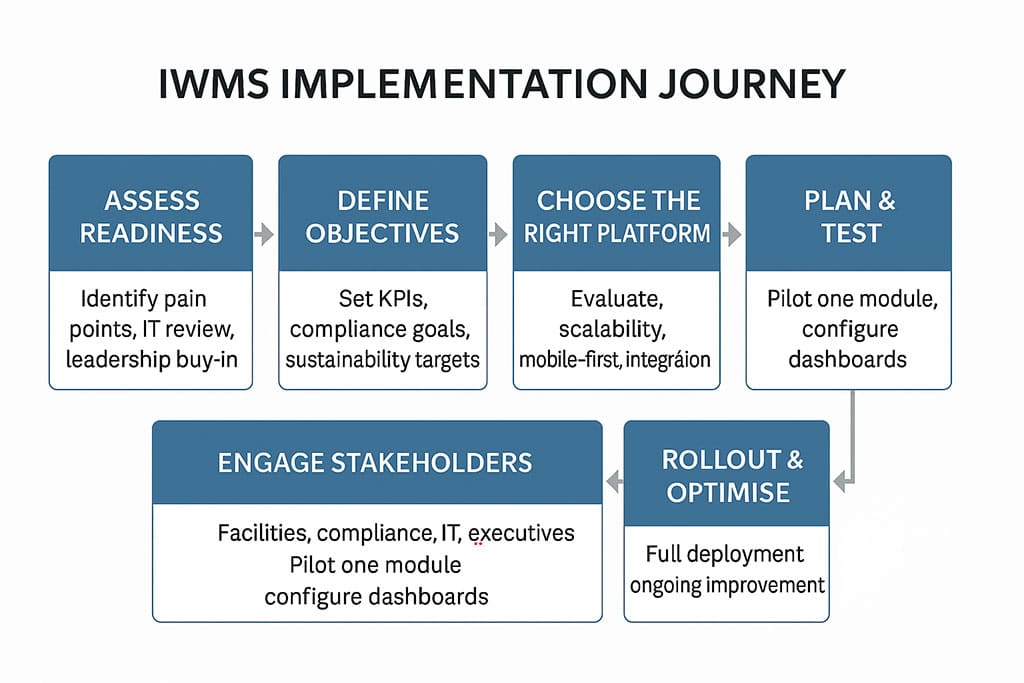
Before you go as far as adopting an IWMS, it will be crucial to evaluate your organisation’s readiness. This should encompass the following steps:
- Identify current pain points: is it the case, for example, that manual processes at your premises are presently leading to a high rate of missed audits or errors? You might have also noticed that data is highly siloed across your company’s various departments. For instance, facilities teams often struggle with inconsistent asset records or delays in compliance reporting.
- Evaluate IT infrastructure: take the time to assess whether your organisation’s current systems would be able to integrate with a modern IWMS. You may be using legacy software or outdated hardware that it will need to upgrade before taking the subsequent step to IWMS adoption.
- Secure leadership buy-in: successful implementation of an IWMS will require support from executives, given the role they will play in allocating resources and championing change. So, you should make sure you engage your own company’s leaders at an early stage, to help align an IWMS with the organisation’s strategic goals.
Carrying out these assessment processes will enable you to highlight the gaps that an IWMS can address, in addition to helping ensure a smoother transition to the new system.
What objectives should you define before starting implementation?
Any IWMS rollout that is done successfully, is underpinned by clearly stated objectives from the outset of the process. So, it will be crucial to determine exactly what “success” will look like for your organisation’s implementation of this software.
Here are some of the objectives that your company may have in relation to its yet-to-be-implemented IWMS:
- Compliance assurance: you should certainly be anxious to ensure your chosen IWMS and its implementation satisfy the pertinent UK regulations, such as the Health and Safety at Work Act.
- Operational efficiency: visible improvement in this regard may come in the form of, for example, reducing audit completion times or minimising asset downtime periods.
- Cost reduction: you will also likely be keen to make sure the adopted IWMS genuinely helps optimise your company’s maintenance budget or reduces the scope for your organisation to be hit with fines.
- Sustainability goals: the climate emergency is not going away and your organisation’s stakeholders will know this, too. So, it will be greatly advantageous if your selected IWMS platform supports ESG (Environmental, Social, Governance) reporting.
Establishing relevant key performance indicators (KPIs), such as audit completion rates, reporting accuracy, or asset uptime, at an early stage, will give you a means of measuring progress.
Aligning these parameters with your company’s broader digital transformation strategy will go a long way to ensuring long-term value from the IWMS, whichever solution is ultimately chosen.
How do you choose the right IWMS platform?
It will be of critical importance to choose the most suitable IWMS in the first place. This will necessitate your organisation paying attention to key criteria like the following, when comparing and whittling down the different available software packages:
- Whether the given platform is cloud-based and scalable. This will greatly help ensure the software is accessible to any authorised individual, based almost anywhere with an Internet connection. It will also give you the confidence that your chosen IWMS will smoothly grow with the organisation, in accordance with its needs at any given time.
- Customisability. Whatever IWMS you’re looking at, you should be sure of its adaptability to your company’s particular compliance needs, for example, in relation to UK fire safety or legionella standards.
- ‘Mobile-first’ functionality. We are in a world in which field teams frequently require access to data “on the go”, whether or not they have access to the Internet at the time. So, if your chosen IWMS incorporates offline capability for remote sites, this is likely to be another significant boost.
- The availability of real-time dashboards. This element of any good IWMS platform will lend itself to the provision of instant insights and in turn, fast and informed decision-making.
You should also research whether the vendor of a given IWMS has specific and in-depth expertise in compliance-heavy, multi-site environments.
It may seem there are a lot of essential boxes to tick here. However, Vision Pro Software excels across all these aspects, being a cloud-based, mobile-first platform with offline capabilities and customisable templates, tailored to UK regulations.
What role does stakeholder engagement play in IWMS success?
Stakeholder buy-in is a major driver of IWMS adoption across all manner of organisations and industries. So, when you are looking to introduce this type of software platform at your organisation, you will need to identify who the relevant stakeholders are, such as facilities managers, compliance officers, IT teams, and/or executive sponsors.
Getting pertinent stakeholders involved at an early stage is important for building ownership and reducing resistance. However, in order to achieve this you will need to communicate the benefits of the IWMS clearly to the individuals in these respective roles.
Here are various ways in which communication can be tailored to each aforementioned group:
- Facilities managers: highlight time savings and the scope for simplified audits.
- Compliance officers: emphasise regulatory assurance and reporting accuracy.
- IT teams: focus on integration and security features.
- Executives: show the return on investment (ROI) they can expect through cost savings and risk mitigation.
Regular updates and feedback loops in your dialogue with these numerous stakeholders, will help maintain their alignment and enthusiasm throughout the IWMS rollout.
How should you plan the implementation process?
A well-structured plan will help guard against any costly missteps. So, here are some of the elements you should consider at the planning stage:
- Phased rollout vs full deployment: by starting with a single module of the given IWMS, such as audits or asset management, you can put yourself in a position to test and refine it to satisfaction, before proceeding to the implementation of further modules.
- Mapping processes to workflows: aligning existing operational processes with the new IWMS can greatly help avoid disruption.
- Budgeting for testing and configuration: you should also allocate time for customising the IWMS platform’s dashboards in accordance with your organisation’s particular needs, as well as the testing of different integrations.
All in all, a phased approach to the implementation of your company’s new IWMS can greatly help minimise risk. It will also be key to building confidence across the teams that will be using the system on a day-to-day basis.
How does Vision Pro Software support successful IWMS implementation?
Vision Pro Software is purpose-built with compliance-heavy industries squarely in mind. It is a cloud-based, all-in-one platform that offers:
- Mobile-first design: the offline functionality of our software greatly supports field teams working on remote sites.
- Customisable templates: Vision Pro Software can be tailored for audits in relation to fire safety, asbestos, or legionella risks.
- Proven efficiency gains: with this renowned platform, reporting time can be shortened by as much as 74%. Meanwhile, Vision Pro Software has also been shown to bring a 68% improvement in risk assessments.
- Dedicated support: expert guidance from the professionals behind Vision Pro Software further helps ensure a smooth, trouble-free rollout.
With its focus on real-world usability and compliance with UK legislation, our IWMS software is a solution that can be rapidly implemented with relatively little hassle. This, in turn, means the given platform can be counted on to begin delivering a meaningful ROI so much sooner.
Conclusion: what does a successful IWMS implementation look like?
A successful IWMS implementation process is one that delivers compliance confidence, operational efficiency, and cost savings. However, if your organisation is to realise this, it will require clear goals, meaningful stakeholder engagement, and the right IWMS partner.
As a scalable, mobile-first platform created with the benefit of high-level industry expertise, Vision Pro Software can greatly help simplify the journey of IWMS adoption.
Are you ready to transform your organisation’s facilities management approach, with a proven solution that can bring genuine long-term value? If so, please don’t hesitate to contact the Vision Pro Software team today. Alternatively, you can book a demo of the Vision Pro Software and see it in action.